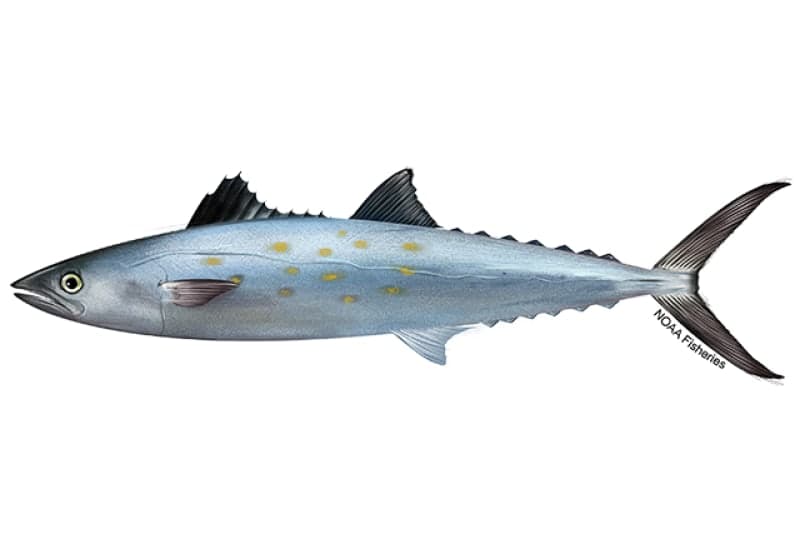
Spanish Mackerel
Scomberomorus maculatus
The fast-and-friendly speedster of piers and beaches — golden-spotted rockets that blitz glass minnows all summer and eat anything small, shiny, and moving fast.
Cast small, shiny, fast. When Spanish are around — and summer piers make it obvious — a silver spoon retrieved quickly catches them until your arm tires.
Quick Catch Plan
ID Characteristics
Use these field marks and context clues to separate spanish mackerel from similar fish before logging or keeping one.
- Overall look: The fast-and-friendly speedster of piers and beaches — golden-spotted rockets that blitz glass minnows all summer and eat anything small, shiny, and moving fast.
- Typical size: 1–3 lb; trophy class: 5 lb+.
- Most likely setting: pier, beach, nearshore, inshore, surf in Gulf Coast, Atlantic Coast, Southeast, Florida, Northeast.
- Where to confirm it: Glass-minnow showers, terns dipping, silver flashes in waves.
- Compared with King mackerel (juvenile): Spanish keep golden spots and have a black flag on the front dorsal; kings have a pronounced lateral line drop and no dorsal flag. Matters legally — kings have a bigger size minimum.
- Compared with Cero mackerel: Cero show a mid-body stripe with spots above and below (S. FL mostly).
Gear Recommendations
- Rod
- 7'–7'6" M fast
- Reel
- 3000–4000
- Main line
- 10–15 lb braid
- Leader
- 30 lb mono or #2–3 light single-strand wire (trade bites for fewer cutoffs)
- Hooks
- Long-shank #1 for bait (protects line from teeth)
- Jigheads
- Small glass-minnow jigs 1/4 oz
- Terminal tackle
- Small swivels prevent line twist from spinning spoons
- Lure sizes
- 1/4–3/4 oz — match the tiny glass minnows
- Lure colors
- Silver, chrome, gold, pink
- Baits
- Live shrimp · Live glass minnows/bull minnows · Fresh cut strips
Any 7' combo + silver spoon + snap swivel. Cast off a pier at sunrise, reel fast. Truly that simple.
Add a Gotcha plug (pier standard) and a spare — cutoffs happen.
Light-wire leaders, speck rigs for doubles, small-boat trolling spread with #00 planers and spoons.
Techniques
- Presentation
- Cast past feeding fish, retrieve fast through them. Erratic snaps of the rod tip trigger cutoff-fast strikes.
- Retrieve
- Fast to very fast; if you're not getting bit, reel faster.
- Positioning
- Watch for birds and surface showers; get up-current of the school.
- Depth
- Surface to 15 ft.
- Structure
- Tide lines, bait pods, pier light shadows, inlet rips.
- Working current
- Feeding stations set up on current edges where glass minnows ball.
Troll small spoons behind planers along the beach; run-and-gun breaking schools.
The classic Gotcha venue — jig vertically or cast and rip.
Spoons at dawn when bait showers in the wash.
Troll a spoon between spots; sight-cast blitzes.
Jetties and inlet walls during tide pushes.
Timing & Conditions
- Seasons
- Late spring through fall; summer is the show.
- Time of day
- Morning bite is the headliner; evening reprise.
- Weather
- Clean green-to-clear water; mud shuts the sight-feeding down.
- Wind
- Light onshore fine; big blows scatter bait and fish.
- Water temp
- 68–85°F.
- Tides
- Moving, either direction — slack is nap time.
- Pressure
- Minor factor.
- Seasonal movement
- Strong seasonal migration up and down both coasts with the 70°F line.
Habitat — Where to Find Them
Beaches, piers, and nearshore waters of the entire southeastern seaboard and Gulf.
- Depth range
- 5–40 ft.
- Look for
- Glass-minnow showers, terns dipping, silver flashes in waves.
- Migration
- Textbook temperature-driven coastal migration in big schools.
Common Mistakes
- Retrieving slow — Spanish ignore slow lures
- Heavy thick leaders that kill strikes (go light wire or 30 lb mono max)
- Oversized lures; match the 2" glass minnows
- No swivel with spoons (line twist chaos)
- Handling carelessly — mackerel teeth slice fingers, use pliers
Catch, Handling & Release
- Landing
- Swing small ones, net bigger; watch teeth every second.
- Handling
- Grip behind the head; pliers for hooks — never fingers in the mouth.
- Release
- Fast-twitch fish that release well if handled quickly.
- Conservation
- Federal/state limits (often 15/day Gulf) with ~12" fork minimums; ID versus juvenile kings matters legally.
Common Lookalikes
Spanish keep golden spots and have a black flag on the front dorsal; kings have a pronounced lateral line drop and no dorsal flag. Matters legally — kings have a bigger size minimum.
Cero show a mid-body stripe with spots above and below (S. FL mostly).
Local Regulations
Size limits, bag limits, seasons, and gear rules change every year and differ by state (and often by individual water). Always verify with the official source before keeping fish.

All state sources for this species
Guide data is editorial and general — conditions, regulations, and fish behavior vary by water. Photo: Wikipedia — Atlantic Spanish mackerel.
