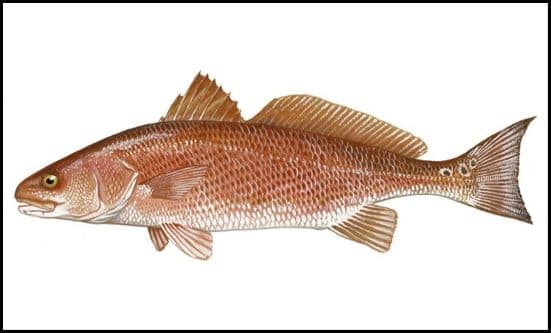
Redfish (Red Drum)
Sciaenops ocellatus
The people's inshore fish of the Gulf and Southeast — copper-flanked, tail-spotted, and catchable from marsh mud to the surf. Reds eat almost anything presented near bottom and pull hard in shallow water.
Find moving water on a flat or marsh edge and put shrimp, mullet, or a gold spoon in front of them. Fall bull-red runs at passes and beaches are the trophy season.
Quick Catch Plan
ID Characteristics
Use these field marks and context clues to separate redfish (red drum) from similar fish before logging or keeping one.
- Overall look: The people's inshore fish of the Gulf and Southeast — copper-flanked, tail-spotted, and catchable from marsh mud to the surf. Reds eat almost anything presented near bottom and pull hard in shallow water.
- Typical size: 18–27 in ('slot' fish); trophy class: 40 in+ 'bull reds'.
- Most likely setting: marsh, flats, inshore, surf, pier in Gulf Coast, Southeast, Atlantic Coast, Florida.
- Where to confirm it: Tails and 'nervous water,' wakes pushing across flats, shrimp popping at drains.
- Compared with Black drum: Black drum have chin barbels and gray/black tones; reds are copper with one or more tail spots and no barbels.
Gear Recommendations
- Rod
- 7'–7'6" M-MH fast spinning
- Reel
- 3000–4000 sealed spinning
- Main line
- 10–20 lb braid
- Leader
- 20–30 lb fluorocarbon, 24"
- Hooks
- 1/0–3/0 circle hooks (bait), 3/0 EWG (weedless plastics)
- Jigheads
- 1/8–3/8 oz
- Terminal tackle
- Popping/clacking corks, egg sinkers for fish-finder rigs, 2–4 oz spider weights in surf
- Lure sizes
- 3–5" plastics, 1/2 oz spoons
- Lure colors
- Gold anything, white, new penny, chartreuse tail in murk
- Baits
- Live shrimp · Cut mullet · Blue crab halves (bull reds) · Live mullet/pinfish
7' medium combo, 15 lb braid, popping cork + 18" leader + live shrimp. Cast to any marsh edge on moving tide.
Add a gold spoon and a bag of paddletails — the whole redfish menu for $15.
Flats skiff or kayak with push pole, 8-wt fly rod for tailers, heavy 10' surf rod with crab baits for fall bulls.
Techniques
- Presentation
- Lead sighted fish by 3–4 ft and let the bait sit — reds track by smell and rush the last foot. Corks: pop hard, pause long.
- Retrieve
- Slow and near bottom; reds feed nose-down. Steady slow-roll for spoons.
- Positioning
- Pole or drift upwind/up-sun across flats; stake out at drain mouths on falling tides.
- Depth
- 6 inches to 6 ft inshore; 10–30 ft for bulls at passes.
- Structure
- Oyster bars, marsh drains, grass edges, pilings, surf troughs.
- Working current
- Feeding stations face into current at structure — cast up-current and swing baits to them.
Pole shallow flats for tailers; run passes for fall schools under birds.
Gulf and Atlantic piers: fish cut bait on bottom off the ends during fall runs.
Fish-finder rigs with cut mullet in the first trough — dawn and dusk.
The redfish craft: silent flats access; anchor at drains on falling water.
Marsh access points and causeway riprap on moving water produce constantly.
Timing & Conditions
- Seasons
- Fantastic year-round in the Gulf; fall is peak everywhere; winter fish school huge and shallow on clear flats.
- Time of day
- Tide beats time of day; low light helps shallow sight-fishing.
- Weather
- Overcast + light wind = ideal stalking. Post-front sun in winter warms mud flats reds crawl onto.
- Wind
- Lee shorelines stay clear; wind-driven water piles bait on points.
- Water temp
- Active 55–90°F; ideal 65–80°F.
- Tides
- Falling tide concentrates everything at drains; incoming floods let reds tail in new grass.
- Moon
- Spring tides (new/full) make bigger water movement — better drain fishing, tougher sight-fishing.
- Pressure
- Reds keep eating through most weather — one reason they're beginner gold.
- Seasonal movement
- Slot fish live inshore year-round; mature bulls move to passes/nearshore to spawn Aug–Oct.
Habitat — Where to Find Them
Estuaries from Virginia to Texas: marsh, grass flats, oyster reefs, beaches, and jetties.
- Depth range
- 0.5–6 ft inshore; 10–40 ft bulls.
- Look for
- Tails and 'nervous water,' wakes pushing across flats, shrimp popping at drains.
- Migration
- Estuary-resident until maturity (~4 yrs), then joining nearshore spawning schools each fall.
Common Mistakes
- Fishing slack tide
- Landing the cast on the fish's head instead of leading it
- Working lures too fast and too high in the column
- Skipping oyster bars to avoid snags (rig weedless)
- Weak leaders around shell — 20 lb minimum
Catch, Handling & Release
- Landing
- Net or lip-grip tool; watch gill plates.
- Handling
- Horizontal support for bulls; they're old fish (30+ yrs).
- Release
- All oversize reds go back — required in most states. Revive thoroughly after long fights.
- Conservation
- Slot limits rule redfish (e.g., 18–27" varies by state); bull reds are protected breeders nearly everywhere.
Common Lookalikes
Black drum have chin barbels and gray/black tones; reds are copper with one or more tail spots and no barbels.
Local Regulations
Size limits, bag limits, seasons, and gear rules change every year and differ by state (and often by individual water). Always verify with the official source before keeping fish.
All state sources for this species
Guide data is editorial and general — conditions, regulations, and fish behavior vary by water. Photo: Wikipedia — Red drum.
