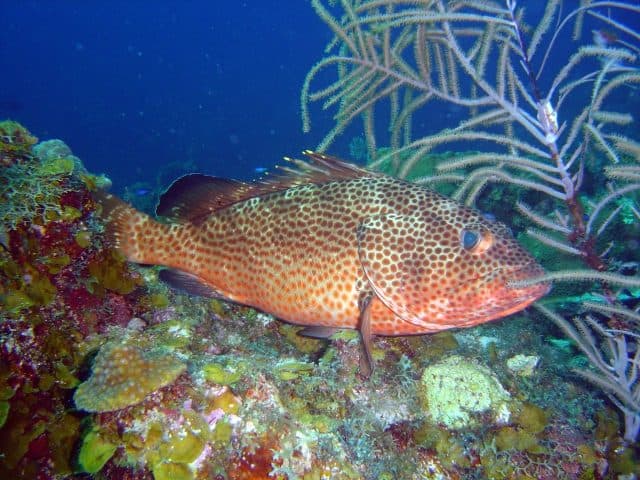
Red Hind
Epinephelus guttatus
A smaller Caribbean/Florida grouper with red spots, reef aggression, and seasonal spawning behavior that demands careful attention to local closures.
Red hind are smaller, structure-tight groupers. Fish compact baits near holes and treat seasonal closure/ID rules seriously.
Quick Catch Plan
ID Characteristics
Use these field marks and context clues to separate red hind from similar fish before logging or keeping one.
- Overall look: A smaller Caribbean/Florida grouper with red spots, reef aggression, and seasonal spawning behavior that demands careful attention to local closures.
- Typical size: 1-4 lb; trophy class: 8 lb+.
- Most likely setting: reef, wreck, nearshore, offshore in Florida, Southeast, Atlantic Coast.
- Where to confirm it: Small holes, coral-head edges, and mixed reef life.
- Compared with Rock hind/coney: Red hind show red spots and a distinctive dark saddle/edge markings; small grouper ID is tricky and local rules can differ.
Gear Recommendations
- Rod
- 7' medium-heavy spinning or light conventional
- Reel
- 4000-6000 spinning or small conventional
- Main line
- 30-50 lb braid
- Leader
- 40-60 lb fluorocarbon
- Hooks
- 2/0-5/0 circle hooks
- Jigheads
- 1-3 oz bucktails/jigs
- Terminal tackle
- Knocker rigs, light fish-finder rigs, descending device
- Lure sizes
- Small whole/cut baits; 1-3 oz jigs
- Lure colors
- White, pink, chartreuse, natural
- Baits
- Shrimp · Squid · Small pilchards · Pinfish · Sardine chunks
Entry point: fish a charter, party boat, or known public reef with Shrimp, squid, or small live bait on 2/0-5/0 hook fished tight to reef holes.. Use stout tackle and practice gaining line immediately after the bite.
A single heavy bottom combo, knocker/fish-finder rigs, and a marked reef list will catch red hind when conditions and seasons line up.
The program: sonar homework for low-pressure bottom, spot-lock/precise anchoring, live bait, high drag, and descending gear ready before the first drop.
Techniques
- Presentation
- Put small baits near reef holes with enough leader to handle abrasion.
- Retrieve
- Short, firm lift to keep them out of the hole, then steady pressure.
- Positioning
- Work patch reefs methodically instead of camping on dead bottom.
- Depth
- 20-200 ft
- Structure
- Coral reefs, rocky holes, patch reefs, and wreck edges.
- Working current
- Light to moderate reef current helps them feed.
Patch reef and reef-hole bottom fishing.
Calm nearshore patch reefs can produce where legal.
Timing & Conditions
- Seasons
- Year-round where open; spawning closures may apply.
- Time of day
- Daytime and low-light reef windows.
- Weather
- Clear reef conditions.
- Wind
- Light enough for controlled drifts.
- Water temp
- Warm reef waters 72-84°F.
- Tides
- Moving current.
- Moon
- Spawning periods can align with moon cycles.
- Pressure
- Pressured reefs require small natural bait.
- Seasonal movement
- Reef-resident with seasonal spawning aggregations.
Habitat — Where to Find Them
Warm coral/rock reef grouper of Florida and Caribbean-influenced waters.
- Depth range
- 20-200 ft
- Look for
- Small holes, coral-head edges, and mixed reef life.
- Migration
- Resident except for spawning aggregation movements.
Common Mistakes
- Misidentifying small groupers
- Ignoring closures
- Fishing too far from holes
- Using oversized bait
- Skipping descending gear from depth
Catch, Handling & Release
- Landing
- Net or swing small legal fish; control near structure.
- Handling
- Spines and gill plates require care.
- Release
- Descend fish from depth.
- Conservation
- Red hind rules are local and may include seasonal/area closures; verify current Florida/federal regulations.
Common Lookalikes
Red hind show red spots and a distinctive dark saddle/edge markings; small grouper ID is tricky and local rules can differ.
Local Regulations
Size limits, bag limits, seasons, and gear rules change every year and differ by state (and often by individual water). Always verify with the official source before keeping fish.

All state sources for this species
Guide data is editorial and general — conditions, regulations, and fish behavior vary by water. Photo: Wikipedia — Red hind.
