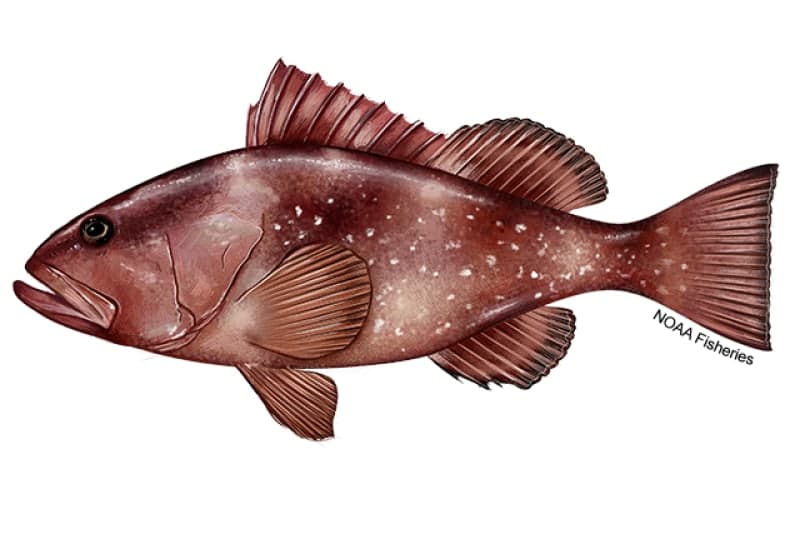
Red Grouper
Epinephelus morio
A reddish-brown live-bottom grouper that digs pits, eats crustaceans and baitfish, and often provides the steadier alternative when gags are shallow or closed.
Red grouper live on lower relief than many anglers expect. Cover live bottom, watch for potholes, and fish sturdy but not absurdly heavy tackle.
Quick Catch Plan
ID Characteristics
Use these field marks and context clues to separate red grouper from similar fish before logging or keeping one.
- Overall look: A reddish-brown live-bottom grouper that digs pits, eats crustaceans and baitfish, and often provides the steadier alternative when gags are shallow or closed.
- Typical size: 5-12 lb; trophy class: 20 lb+.
- Most likely setting: reef, wreck, nearshore, offshore, inshore in Gulf Coast, Florida, Southeast, Atlantic Coast.
- Where to confirm it: Low hard returns, scattered relief, and bait near sandy openings.
- Compared with Gag grouper: Red grouper are warmer reddish-brown with pale blotches and a more rounded profile; gags are gray-brown with wavy markings.
Gear Recommendations
- Rod
- 6'-7' heavy bottom rod
- Reel
- Conventional or 8000 spinning
- Main line
- 50-65 lb braid
- Leader
- 60-80 lb fluorocarbon
- Hooks
- 6/0-8/0 circle hooks
- Jigheads
- 150-250 g jigs or 2-6 oz bucktails
- Terminal tackle
- Knocker rigs, fish-finder rigs, 4-12 oz sinkers
- Lure sizes
- Medium whole/cut baits; 150-250 g jigs
- Lure colors
- Pink, glow, chartreuse, natural
- Baits
- Squid · Sardines · Pinfish · Threadfins · Octopus
Entry point: fish a charter, party boat, or known public reef with Cut squid/sardine or live pinfish on a 6/0-8/0 circle near bottom.. Use stout tackle and practice gaining line immediately after the bite.
A single heavy bottom combo, knocker/fish-finder rigs, and a marked reef list will catch red grouper when conditions and seasons line up.
The program: sonar homework for low-pressure bottom, spot-lock/precise anchoring, live bait, high drag, and descending gear ready before the first drop.
Techniques
- Presentation
- Keep bait on bottom around live-bottom patches and potholes.
- Retrieve
- Wind immediately but reds often fight more straight-up than gags once clear.
- Positioning
- Drift/spot-lock across low relief until bites identify the productive patch.
- Depth
- 40-300 ft
- Structure
- Low-profile live bottom, potholes, ledges, and limestone hard bottom.
- Working current
- Light to moderate current spreads scent and positions fish.
Bottom-fish live-bottom and potholes with bait or jigs.
Possible on nearshore Gulf hard bottom in calm weather.
Timing & Conditions
- Seasons
- Year-round where open; check quotas/closures.
- Time of day
- Daytime bottom fishing.
- Weather
- Safe offshore/nearshore seas.
- Wind
- Light enough for bottom contact.
- Water temp
- Best 66-82°F.
- Tides
- Moderate current.
- Moon
- Minor.
- Pressure
- Minor.
- Seasonal movement
- More resident on live-bottom than gag, with seasonal depth shifts.
Habitat — Where to Find Them
Gulf and South Atlantic live-bottom grouper that often favors low limestone relief and sand/rock potholes.
- Depth range
- 40-300 ft
- Look for
- Low hard returns, scattered relief, and bait near sandy openings.
- Migration
- Mostly local depth shifts; less dramatic than gag.
Common Mistakes
- Only fishing high-profile wrecks
- Too much weight dragging into snags
- Ignoring low-relief bottom
- Not checking quota closures
- Poor deep-release practice
Catch, Handling & Release
- Landing
- Gaff legal fish after clearing bottom.
- Handling
- Spines and gill plates need care.
- Release
- Use descending devices from depth.
- Conservation
- Red grouper seasons, quotas, and size limits change; verify current Gulf/Atlantic rules.
Common Lookalikes
Red grouper are warmer reddish-brown with pale blotches and a more rounded profile; gags are gray-brown with wavy markings.
Local Regulations
Size limits, bag limits, seasons, and gear rules change every year and differ by state (and often by individual water). Always verify with the official source before keeping fish.

All state sources for this species
Guide data is editorial and general — conditions, regulations, and fish behavior vary by water. Photo: Wikipedia — Red grouper.
