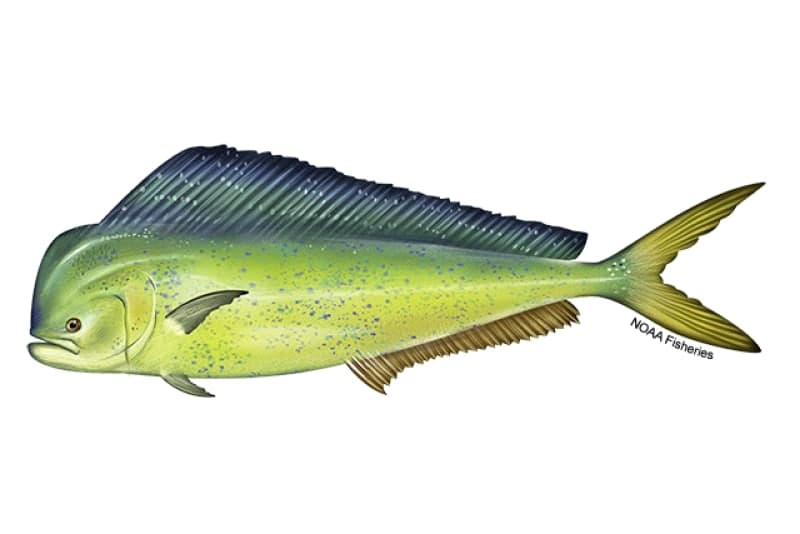
Mahi-Mahi (Dolphinfish)
Coryphaena hippurus
The neon acrobat of the bluewater — electric green-gold, absurdly fast-growing, and drawn to anything floating. Find a weedline, and summer magic follows.
Run-and-gun the blue water: troll until you find weedlines, birds, or debris, then pitch bait to the school and keep one hooked fish in the water to hold the rest.
Quick Catch Plan
ID Characteristics
Use these field marks and context clues to separate mahi-mahi (dolphinfish) from similar fish before logging or keeping one.
- Overall look: The neon acrobat of the bluewater — electric green-gold, absurdly fast-growing, and drawn to anything floating. Find a weedline, and summer magic follows.
- Typical size: 5–15 lb ('schoolies'); 15–30 lb ('gaffers'); trophy class: 40 lb+ bulls.
- Most likely setting: offshore in Florida, Gulf Coast, Atlantic Coast, Southeast, Northeast.
- Where to confirm it: Sargassum lines, frigatebirds, flying fish showers, floating junk of any kind.
- Compared with Pompano dolphinfish: A smaller cousin with a deeper body relative to length and shorter dorsal base — often mixed into schools.
Gear Recommendations
- Rod
- 6'6"–7' 20–30 lb class
- Reel
- 20–30 conventional or 6000–8000 spinning
- Main line
- 30 lb mono (troll) or 40 lb braid (spin)
- Leader
- 40–60 lb fluorocarbon, 5 ft
- Hooks
- 5/0–7/0 for ballyhoo; 4/0 J or circle for chunks
- Jigheads
- 1–2 oz bucktails for the pitch
- Terminal tackle
- Snap swivels for trolling, casting rods rigged plain
- Lure sizes
- 6–9" skirts, small feathers
- Lure colors
- Blue/white, pink/white, green/yellow (the mahi trifecta)
- Baits
- Rigged ballyhoo · Squid chunks · Live pilchards · Cut bonita strips
Charter or split-charter first — mahi are about seamanship; the fishing is the easy part.
Small boat, two trolling rods, one pitch rod, and a course along the color change.
Satellite SST/chlorophyll homework, a full spread with teasers, and a livewell of pilchards for schools.
Techniques
- Presentation
- Troll to locate; once a fish hooks up, slow-pitch chunks/lives to the school that follows it to the boat.
- Retrieve
- Fast erratic for casting; mahi chase — speed excites them.
- Positioning
- Work the clean side of weedlines; circle debris wide before committing.
- Depth
- Top 50 ft of very deep water.
- Structure
- Weedlines, boards, pallets, buoys, rips, frigatebirds' airspace.
- Working current
- Edges of the Gulf Stream/loop current concentrate everything.
The whole playbook above.
Offshore-capable kayakers troll edges within safe range — real but expert-only.
Timing & Conditions
- Seasons
- April–September widely; winter in the Keys.
- Time of day
- All day; morning gets the freshest edges.
- Weather
- 2–4 ft or better; blue water access days.
- Wind
- Sea state gates the trip, not the bite.
- Water temp
- 75–84°F.
- Tides
- Open-ocean currents replace tides here.
- Moon
- Minor.
- Pressure
- Minor.
- Seasonal movement
- Highly migratory; they live fast (5 yrs max) and move constantly.
Habitat — Where to Find Them
Blue offshore water on both coasts in season — usually 100+ ft depths out to the Stream.
- Depth range
- Surface-oriented over deep water.
- Look for
- Sargassum lines, frigatebirds, flying fish showers, floating junk of any kind.
- Migration
- Constant, current-riding, temperature-following.
Common Mistakes
- Boating every fish immediately — leave one in the water to anchor the school
- Trolling past debris without a full circle
- Ignoring birds (frigates mark fish from miles)
- Wire leaders (drops bites; use fluoro)
- Green-fish chaos in the cockpit — gaff shots and cooler discipline matter
Catch, Handling & Release
- Landing
- Gaff keepers into the fish box in one motion; they go berserk on deck.
- Handling
- Watch the thrash; bleed and ice immediately for the table.
- Release
- Fast fish, release well if kept wet and brief.
- Conservation
- FL: 20" fork min Atlantic side, bag limits tightened recently — check current rules; federal HMS rules don't apply but state ones do.
Common Lookalikes
A smaller cousin with a deeper body relative to length and shorter dorsal base — often mixed into schools.
Local Regulations
Size limits, bag limits, seasons, and gear rules change every year and differ by state (and often by individual water). Always verify with the official source before keeping fish.

All state sources for this species
Guide data is editorial and general — conditions, regulations, and fish behavior vary by water. Photo: Wikipedia — Mahi-mahi.
