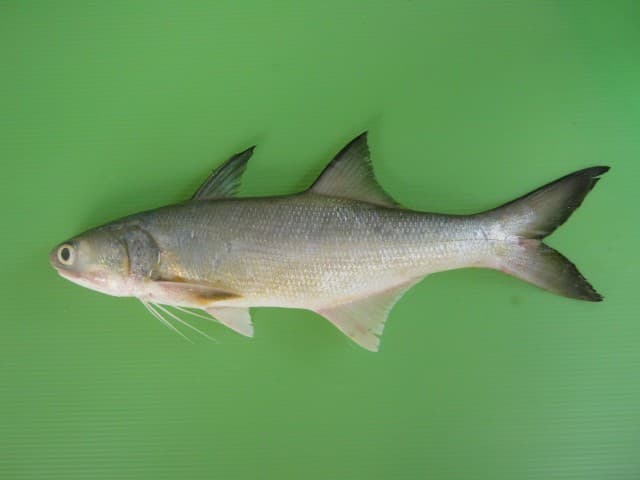
Eleutheronema tetradactylum
The kurau — a prized silver estuary and surf fish that feeds on prawns and baitfish over sand and mud. Threadfin use fingerlike lower fin rays to feel for food, fight with strong runs, and are among the most sought-after eating and sport fish along the region's coasts.
Threadfin work sand and mud flats, estuary mouths, and surf gutters, feeling for prawns and baitfish with their fin filaments. Present live prawns, soft vibes, and plastics near the bottom on a moving tide, and expect strong, dogged runs. They roam, so covering water and timing the tide are the keys.
Guide data is editorial and general — conditions, regulations, and fish behavior vary by water. Photo: Wikipedia — Fourfinger threadfin.
Use these field marks and context clues to separate fourfinger threadfin from similar fish before logging or keeping one.
Match a rig to Fourfinger Threadfin with the Setup Builder, or browse all setups.
Drift flats and current lanes, hopping vibes to search for schools.
Fish gutters and sandbar edges as the tide pushes bait through.
Surf gutters and estuary mouths on the tide are prime land-based threadfin ground.
Fish of sand and mud flats, estuary mouths, and surf zones, feeling along the bottom for prawns and baitfish.
Barramundi have a sloped head and pearly eye; threadfin have a rounded snout, underslung mouth, and free fingerlike fin rays.
Count the free pectoral filaments — the fourfinger has four; body is bright silver with yellow-tinged fins.
Size limits, bag limits, seasons, and gear rules change every year and differ by country and province (and often by individual water). Always verify with the official source before keeping fish.