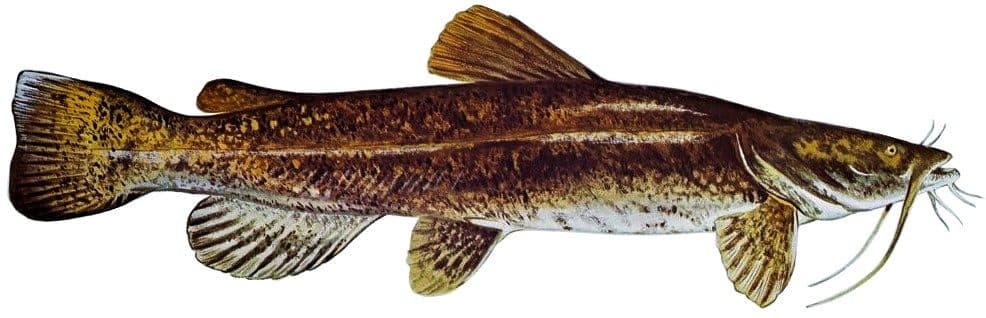
Flathead Catfish
FreshwaterIn season now

Flathead Catfish

Pylodictis olivaris

A solitary ambush predator that eats live fish almost exclusively. Flatheads live in the nastiest wood cover in the river and come out at night — the big-game hunt of catfishing.

Typical size
5–25 lb
Trophy class
40 lb+ (record 123 lb)
Challenging

Live bait, heavy tackle, big wood, after dark. Flatheads don't scavenge — a lively bluegill struggling next to a log jam at midnight is the whole playbook.

Quick Catch Plan

Best bait right now
Lively 4–6" bluegill on an 8/0 circle hook, fished on the edge of a log jam
Recommended lure
Bait only — must be alive and kicking
Setup
8' heavy rod, size 60 round reel, 80 lb braid, 60 lb mono leader
Where to go
River log jams, outside bends with timber, deep holes with wood
Best time
Sunset to 2 a.m.
Season notes
June–August after the spawn is peak; a warm summer night with stable flow is ideal.

ID Characteristics

Use these field marks and context clues to separate flathead catfish from similar fish before logging or keeping one.

  • Overall look: A solitary ambush predator that eats live fish almost exclusively. Flatheads live in the nastiest wood cover in the river and come out at night — the big-game hunt of catfishing.
  • Typical size: 5–25 lb; trophy class: 40 lb+ (record 123 lb).
  • Most likely setting: river, lake, creek in Midwest, South Central, Southeast.
  • Where to confirm it: The gnarliest wood in the deepest bend of the river.
  • Compared with Channel/blue catfish: Flatheads have a flattened head, underbite, mottled yellow-brown color, and a rounded (not forked) tail.

Gear Recommendations

Rod
7'6"–8' heavy, strong backbone
Reel
Size 60–70 round baitcaster with clicker
Main line
65–80 lb braid or 40 lb+ mono
Leader
50–80 lb mono
Hooks
6/0–10/0 heavy-wire circle hooks
Terminal tackle
2–5 oz no-roll sinkers, heavy 3-way swivels, float rigs to keep bait above snags
Lure sizes
n/a
Lure colors
n/a
Baits
Live bluegill (where legal) · Live bullheads (tough, last all night) · Big live shad · Giant creek chubs
Beginner setup

One heavy combo, 50 lb mono, live bluegill under a big float drifted along a log jam edge at dusk.

Budget setup

Heavy combo + rod holder spike + headlamp + aerated bait bucket.

Serious angler

Multiple heavy rods, bank poles/limb lines where legal, boat with spot-lock to hold on jams, big livewell for bait.

Techniques

Presentation
Pin a live bait just outside the wood — close enough to be seen, far enough not to snag instantly. Check bait energy every 30 min.
Retrieve
None. When the clicker screams, engage and hold on — steer the fish away from the jam immediately.
Positioning
Set up so the fight pulls fish away from cover; upstream of the jam is usually right.
Depth
5–25 ft holes with wood; flatheads roam shallow flats at night to feed.
Structure
Log jams, root wads, undercut banks, bridge pilings, dam scour holes.
Working current
Moderate current outside bends builds the wood piles flatheads live in.
boat fishing

Hold on spot-lock at the hole's edge; fight fish hard away from timber.

kayak fishing

Doable but sporty — a 30 lb flathead tows a kayak. Use heavy anchor discipline near wood.

shore fishing

Very shore-friendly: pick one good jam, set two rods, and commit the night to it.

Timing & Conditions

Seasons
Summer nights are the season. Fall pre-winter feed is underrated. Nearly dormant in cold water.
Time of day
Night, full stop. Dawn/dusk edges in stained water.
Weather
Warm, muggy, stable nights; a slight river rise gets them moving.
Wind
Non-factor at night on rivers; matters only for boat control.
Water temp
Active 65–85°F; below 55°F they hole up and barely eat.
Pressure
Stable-to-falling; big post-front blue skies are slow.
Seasonal movement
Fish a hole-to-flat circuit nightly; seasonal moves to deep wintering holes where they stack up (protect these — some states close them).

Habitat — Where to Find Them

Warm rivers and reservoirs of the Midwest and South; introduced (and invasive) in some Atlantic drainages.

Depth range
5–30 ft holes; night feeding as shallow as 2 ft.
Look for
The gnarliest wood in the deepest bend of the river.
Migration
Home range around a few holes; long moves only to spawn cavities and wintering holes.
log jamsroot wadsundercut banksscour holestimbered bends

Common Mistakes

  • Dead or lazy bait — flatheads want panic vibrations
  • Light tackle that loses every fish in the wood
  • Impatience — flathead fishing is a one-spot, all-night commitment
  • Fishing the middle of the hole instead of the wood edge
  • Giving up after the spawn lull in early summer

Catch, Handling & Release

Landing
Big net or a confident lower-jaw grip (watch the sandpaper teeth — use a glove).
Handling
Horizontal support always; they're stronger than they look on the bank.
Release
Big flatheads are 15–25 years old and are the river's population engine — release them. Eaters: 5–10 lb.
Conservation
Live bait rules vary a lot by state (bluegill legal in some, banned in others) — verify before baiting up.

Common Lookalikes

Channel/blue catfish

Flatheads have a flattened head, underbite, mottled yellow-brown color, and a rounded (not forked) tail.

Guide data is editorial and general — conditions, regulations, and fish behavior vary by water. Photo: Wikipedia — Flathead catfish.