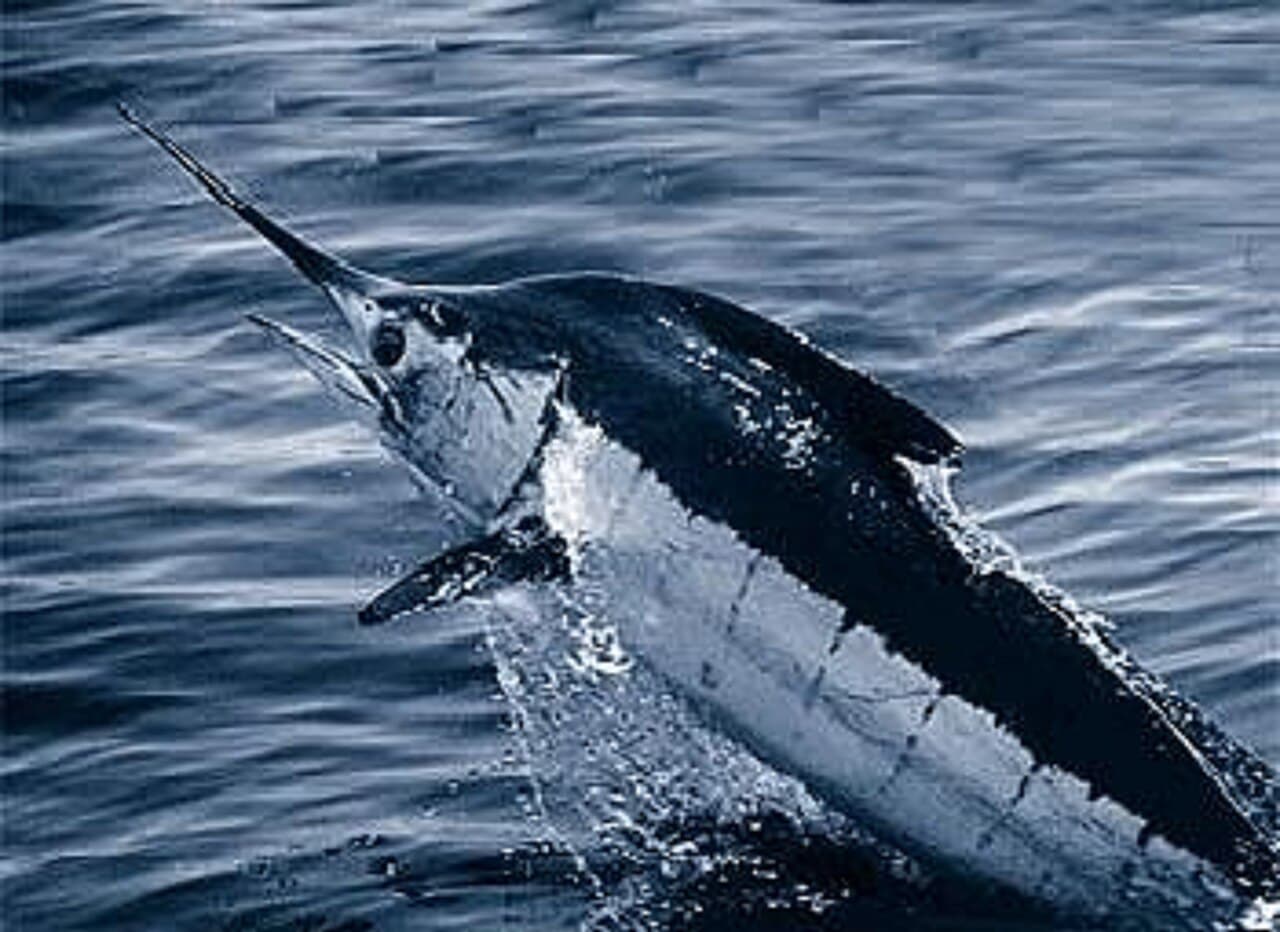
Blue Marlin
Makaira nigricans
The heavyweight champion — a quarter-ton of violence that eats trolled lures meant for fish a tenth its size and turns cockpits into scrambles. The apex of American big-game fishing.
Big lures, big spread, big water: troll the canyons and rips at 7–9 kts and be drilled on the drop-back when chaos erupts. This is a team sport played standing up.
Quick Catch Plan
ID Characteristics
Use these field marks and context clues to separate blue marlin from similar fish before logging or keeping one.
- Overall look: The heavyweight champion — a quarter-ton of violence that eats trolled lures meant for fish a tenth its size and turns cockpits into scrambles. The apex of American big-game fishing.
- Typical size: 100–300 lb; trophy class: 500 lb+ ('granders' at 1000).
- Most likely setting: offshore in Gulf Coast, Atlantic Coast, Florida, Southeast.
- Where to confirm it: Bait + birds + blue water + a temperature edge. Then troll with faith.
- Compared with White marlin: Whites are 50–80 lb with rounded fins; a blue's pointed dorsal/anal fins and cobalt shoulder mark the real thing.
Gear Recommendations
- Rod
- 50-wide (light) to 130 class trolling rods
- Reel
- 50W–130 lever drags, hundreds of yards of capacity
- Main line
- 80–130 lb mono or hollow braid with topshots
- Leader
- 300–500 lb mono/fluoro wind-ons
- Hooks
- 10/0–12/0 in lure rigs; 16/0+ circles for big natural baits
- Jigheads
- n/a
- Terminal tackle
- Crimps, chafe gear, snap-swivel-free wind-on systems, gloves for wiring
- Lure sizes
- 10–16"
- Lure colors
- Blue/white, black/purple, green/black — dark days dark lures
- Baits
- Horse ballyhoo · Rigged Spanish mackerel · Live 5–15 lb blackfin/skipjack
Crew on someone else's boat or charter the Gulf rigs — marlin fishing is apprenticeship.
There isn't one, honestly; split charters are the entry.
The program: tournament-grade tackle, tuna tubes, a wireman's gloves and nerve, sea time measured in seasons.
Techniques
- Presentation
- A well-spaced 4–6 lure spread swimming clean at 7–9 kts; teasers pulling fish to pitch baits on heavy spin gear for the hot fish.
- Retrieve
- Drop back on the strike, then hammer the drag at 'strike' once tight; the angler winds, the captain chases, the crew clears.
- Positioning
- The captain fights the fish with the boat — backing down, quartering; the rod just holds on.
- Depth
- Surface spread over 500–5000 ft.
- Structure
- Canyon walls, rips, rigs, temperature breaks, bait concentrations.
- Working current
- Blue water pushed against structure — same story, biggest scale.
Exclusively, and ideally one with a fighting chair and a tower.
Timing & Conditions
- Seasons
- May–October US waters; Gulf peaks mid-summer.
- Time of day
- All trolling hours; midday raises fish too.
- Weather
- Multi-day offshore weather windows; safety is the first tackle decision.
- Wind
- Sea state gates everything.
- Water temp
- 78–84°F pockets and edges.
- Tides
- Ocean current features only.
- Moon
- Debated forever; fish when you can go.
- Pressure
- Minor versus current/bait factors.
- Seasonal movement
- True ocean wanderers; managed internationally.
Habitat — Where to Find Them
The deep blue: Gulf rigs and canyons, the Stream edge off the Carolinas/mid-Atlantic canyons.
- Depth range
- Surface over abyssal water.
- Look for
- Bait + birds + blue water + a temperature edge. Then troll with faith.
- Migration
- Trans-oceanic; a tagged Gulf blue may summer off Africa.
Common Mistakes
- Loose drags/old line on the one bite of the season
- Wiring without gloves or training (genuinely dangerous)
- Spreads tangled by impatient turns
- Keeping fish that should swim — release is the norm and often the rule (tournament minimums are huge)
- Skimping on crew briefing before lines in
Catch, Handling & Release
- Landing
- Wind-on to the wireman, bill-hold boatside, hooks out or leader cut close.
- Handling
- Fish stays in the water; a green marlin boatside is a safety event, not a photo op.
- Release
- Standard practice; revive with forward idle until the lit-up colors return.
- Conservation
- Federal HMS permit; 99" LJFL minimum for any retention; nearly universal release culture; report all interactions per HMS rules.
Common Lookalikes
Whites are 50–80 lb with rounded fins; a blue's pointed dorsal/anal fins and cobalt shoulder mark the real thing.
Local Regulations
Size limits, bag limits, seasons, and gear rules change every year and differ by state (and often by individual water). Always verify with the official source before keeping fish.
All state sources for this species
Guide data is editorial and general — conditions, regulations, and fish behavior vary by water. Photo: Wikipedia — Atlantic blue marlin.
