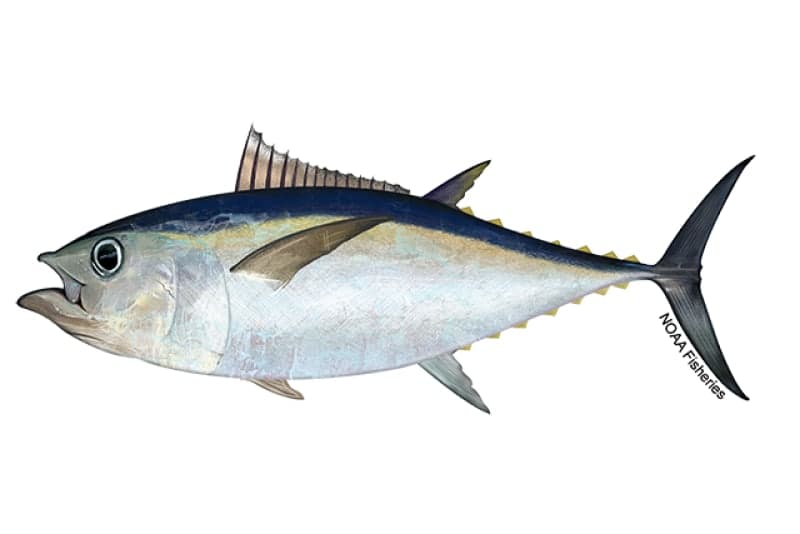
Bigeye Tuna
Thunnus obesus
The deepwater canyon bruiser and night-bite specialist — deeper, rounder, and bigger-eyed than a yellowfin, holding down in the cool water by day and crushing spreads at first light. A true offshore trophy.
A canyon game. Troll spreader bars and ballyhoo at first light and last light, or work deep jigs down to fish holding under the thermocline. The bigeye bite is often a dawn-and-dusk affair with brief, violent windows.
Quick Catch Plan
ID Characteristics
Use these field marks and context clues to separate bigeye tuna from similar fish before logging or keeping one.
- Overall look: The deepwater canyon bruiser and night-bite specialist — deeper, rounder, and bigger-eyed than a yellowfin, holding down in the cool water by day and crushing spreads at first light. A true offshore trophy.
- Typical size: 60–150 lb; trophy class: 200 lb+.
- Most likely setting: offshore in Northeast, Atlantic Coast, Gulf Coast.
- Where to confirm it: Sharp temp/color breaks, bait marks deep on the sounder, and low-light surface activity.
- Compared with Yellowfin tuna: Bigeye have a distinctly larger eye, a deeper/rounder body, shorter finlets, and lack the long dorsal/anal lobes; a same-size bigeye also has a longer pectoral fin than a yellowfin.
- Compared with Albacore: Albacore's pectoral fin is extremely long (past the anal fin); bigeye's is moderate. Albacore stay much smaller.
Gear Recommendations
- Rod
- 50–80 lb-class trolling stand-up; heavy jigging rod for the deep bite
- Reel
- 50–80 wide two-speed conventional; large-capacity jigging reel
- Main line
- 80–130 lb; heavy braid for deep jigging
- Leader
- 130–200 lb fluorocarbon for trolling; 100–130 for jigs
- Hooks
- 9/0–11/0 on bait/bars; heavy assist hooks on jigs
- Jigheads
- n/a; deep jigs 250–400 g
- Terminal tackle
- Heavy crimped wind-ons, quality swivels, chafe gear
- Lure sizes
- Spreader bars, 9"+ ballyhoo/skirts, 250–400 g jigs
- Lure colors
- Green/black and purple/black bars, glow jigs for the deep bite
- Baits
- Ballyhoo (troll) · Butterfish/squid (chunk) · Deep jigs
An overnight canyon charter is the only realistic entry point.
Share an overnight canyon run and bring a heavy jigging combo.
Full spreader-bar spread, quality sounder/temperature charts to find the tips and breaks, and a day-time deep-jig program with the crew rested for dawn.
Techniques
- Presentation
- Troll bars/ballyhoo through the low-light windows; when they sound, drop heavy jigs to the marks deep in the water column.
- Retrieve
- Trolling speed 6–8 kn; jigs worked fast and high off the bottom or through mid-water marks.
- Positioning
- Work the up-current tips and edges of canyons where bait and thermal breaks stack fish.
- Depth
- Feeds shallow at low light; retreats below the thermocline (300–800 ft) by day.
- Structure
- Canyon walls, tips, seamounts, and sharp temperature/color breaks.
- Working current
- Edges and rips over the deep concentrate the food chain.
An offshore, often overnight, boat fishery — trolling plus deep jigging.
Timing & Conditions
- Seasons
- Summer into fall at the Northeast/Mid-Atlantic canyons.
- Time of day
- Dawn and dusk are the money windows; some night action.
- Weather
- Overnight, far-offshore trips demand a solid weather window.
- Wind
- Safe, settled seas required for the long run.
- Water temp
- Keys on breaks near 68–74°F surface, cool water below.
- Tides
- Current over canyon structure matters more than tidal stage.
- Moon
- Bright moons can spread the bite; low light still rules.
- Pressure
- Minor.
- Seasonal movement
- Highly migratory; follows deep thermal structure and bait offshore.
Habitat — Where to Find Them
Deep offshore water along canyon systems and temperature breaks, where the fish yo-yo through the thermocline daily.
- Depth range
- Surface at low light to 800+ ft by day, over thousands of feet.
- Look for
- Sharp temp/color breaks, bait marks deep on the sounder, and low-light surface activity.
- Migration
- Ocean-basin migrator tracking thermal structure and bait.
Common Mistakes
- Missing the tight dawn/dusk windows by setting lines late
- Trolling only — ignoring the productive daytime deep-jig bite
- Light leaders/hardware for a big, hard-charging fish
- Fishing the middle of the canyon instead of the up-current tips and edges
- Inadequate chilling on a premium-meat fish
Catch, Handling & Release
- Landing
- Multiple gaffs and a coordinated crew for big fish.
- Handling
- Bleed and ice-slurry immediately; bigeye is prized table fare.
- Release
- Revive undersized fish boatside with water over the gills before release.
- Conservation
- Atlantic bigeye fall under NOAA HMS 'BAYS' tuna rules (27" curved fork length minimum) and require an HMS permit; retention and limits can change in-season — verify before the trip.
Common Lookalikes
Bigeye have a distinctly larger eye, a deeper/rounder body, shorter finlets, and lack the long dorsal/anal lobes; a same-size bigeye also has a longer pectoral fin than a yellowfin.
Albacore's pectoral fin is extremely long (past the anal fin); bigeye's is moderate. Albacore stay much smaller.
Local Regulations
Size limits, bag limits, seasons, and gear rules change every year and differ by state (and often by individual water). Always verify with the official source before keeping fish.

All state sources for this species
Guide data is editorial and general — conditions, regulations, and fish behavior vary by water. Photo: Wikipedia — Bigeye tuna.
