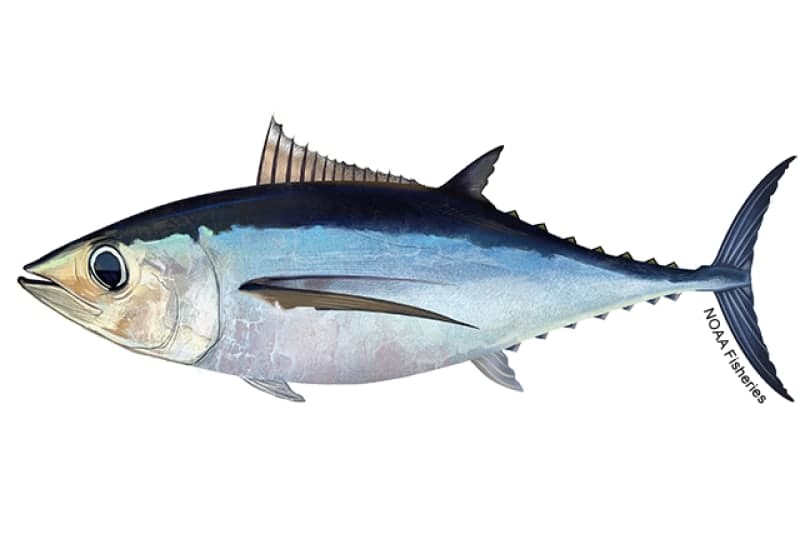
Albacore (Longfin Tuna)
SaltwaterIn season now

Albacore (Longfin Tuna)

Thunnus alalunga

The West Coast's summer staple and the original 'chicken of the sea' — the white-meat tuna with absurdly long, wing-like pectoral fins. Off California, Oregon, and Washington, albacore fuel a beloved run-and-gun troll-and-bait fishery.

Typical size
10–30 lb
Trophy class
40 lb+
Moderate

Troll a spread of jigs and cedar plugs at 6–8 knots until you get bit, then stop the boat and 'bait-stop' the school with live anchovies or sardines. Blind-troll the temperature breaks offshore until you find the warm blue water they love.

Quick Catch Plan

Best bait right now
Live anchovy or sardine fly-lined on light fluoro once the school is stopped behind the boat
Recommended lure
Trolled tuna clones/feathers and cedar plugs at 6–8 kn
Setup
Troll: 30–40 lb conventional. Bait: 7'–8' medium live-bait rod, 25–40 lb, fly-line
Where to go
Offshore temperature/color breaks in 58–66°F blue water, often 20–60+ miles out
Best time
Mid-summer through fall; midday blind-trolling is productive
Season notes
The Pacific albacore run builds through summer and peaks late summer into fall as warm water pushes toward the coast.

ID Characteristics

Use these field marks and context clues to separate albacore (longfin tuna) from similar fish before logging or keeping one.

  • Overall look: The West Coast's summer staple and the original 'chicken of the sea' — the white-meat tuna with absurdly long, wing-like pectoral fins. Off California, Oregon, and Washington, albacore fuel a beloved run-and-gun troll-and-bait fishery.
  • Typical size: 10–30 lb; trophy class: 40 lb+.
  • Most likely setting: offshore in Pacific Coast, Pacific Northwest, West.
  • Where to confirm it: 58–66°F blue water, jumping fish, birds, and 'meter marks' offshore.
  • Compared with Other tunas: The pectoral fin is diagnostic — it's extremely long, reaching well past the anal fin. No other tuna in US waters has fins like that.
  • Compared with Bigeye/yellowfin: Both have short-to-moderate pectorals and (in yellowfin) yellow finlets; albacore's meat is white, theirs is red/pink.

Gear Recommendations

Rod
Troll: 30–40 lb conventional. Bait: 7'–8' medium fast live-bait rod
Reel
Star-drag/2-speed conventional (troll); 4000–6000 spinning or conventional (bait)
Main line
40–65 lb braid or 30–40 lb mono
Leader
25–40 lb fluorocarbon; drop lighter when the bite is finicky
Hooks
1/0–3/0 live-bait hooks; ringed hooks on trolling clones
Jigheads
n/a
Terminal tackle
Fluoro leader, minimal hardware; heavier trolling leaders on the clones
Lure sizes
Tuna clones/feathers 4–6", cedar plugs, Mexican flag/zucchini patterns
Lure colors
Mexican flag, zucchini, black/purple, pink; natural live bait
Baits
Live anchovies · Live sardines · Trolled cedar plugs/clones
Beginner setup

Book a West Coast albacore charter or overnight — they run the troll spread and supply live bait.

Budget setup

One light conventional troll combo + a bait rod covers most trips; split fuel on a long-range day.

Serious angler

A full troll spread, a big live-bait tank, and offshore SST/chlorophyll charts to run to the warm-water breaks efficiently.

Techniques

Presentation
Blind-troll to find them, then 'bait-stop': stop the boat, chum live bait, and fly-line hooked baits into the boiling school on light fluoro.
Retrieve
Troll 6–8 kn; fly-lined baits swim free with an open bail/thumb until bit.
Positioning
Keep the stopped boat drifting with the school behind it; keep bait in the water to hold them up.
Depth
Surface-oriented in the warm layer; they feed up in the trolling spread.
Structure
No hard structure — temperature and color breaks in open ocean are the 'structure'.
Working current
Warm-water fingers and current edges concentrate bait and albacore.
boat fishing

A West Coast offshore run-and-gun troll-and-bait fishery.

Timing & Conditions

Seasons
Summer through fall off CA/OR/WA.
Time of day
Trolling produces all day; low light can spark the bait bite.
Weather
Long offshore runs need a good weather window.
Wind
Settled seas for the 20–60+ mile runs.
Water temp
Key on 58–66°F clean blue water — the single most important factor.
Tides
Open-ocean temp breaks matter more than tide.
Moon
Minor.
Pressure
Minor.
Seasonal movement
Trans-Pacific migrator; the run tracks warm water toward the coast each summer.

Habitat — Where to Find Them

Cool-temperate open Pacific, holding in the warm-water fingers and breaks that push toward the West Coast in summer.

Depth range
Upper water column in the warm surface layer.
Look for
58–66°F blue water, jumping fish, birds, and 'meter marks' offshore.
Migration
Long trans-Pacific migrations; predictable seasonal West Coast run.
temperature breakscolor/chlorophyll breakscurrent edges

Common Mistakes

  • Fishing green/cold water — find the 58–66°F blue break first
  • Trolling too fast or too slow (dial in ~7 kn)
  • Heavy leader on a finicky bait-stop bite
  • Not keeping live bait in the water to hold the stopped school
  • Slow to bleed/chill the catch

Catch, Handling & Release

Landing
Gaff or swing smaller fish; they green-fight hard boatside.
Handling
Bleed and ice immediately — albacore's white meat is excellent fresh or canned.
Release
Revive and release fish you won't keep; they tire quickly.
Conservation
No federal minimum size on the Pacific coast, but state and (for charter/commercial) federal rules and any in-season limits apply — check current CA/OR/WA regulations before keeping.

Common Lookalikes

Other tunas

The pectoral fin is diagnostic — it's extremely long, reaching well past the anal fin. No other tuna in US waters has fins like that.

Bigeye/yellowfin

Both have short-to-moderate pectorals and (in yellowfin) yellow finlets; albacore's meat is white, theirs is red/pink.

Local Regulations

Size limits, bag limits, seasons, and gear rules change every year and differ by state (and often by individual water). Always verify with the official source before keeping fish.
All state sources for this species

Guide data is editorial and general — conditions, regulations, and fish behavior vary by water. Photo: Wikipedia — Albacore.